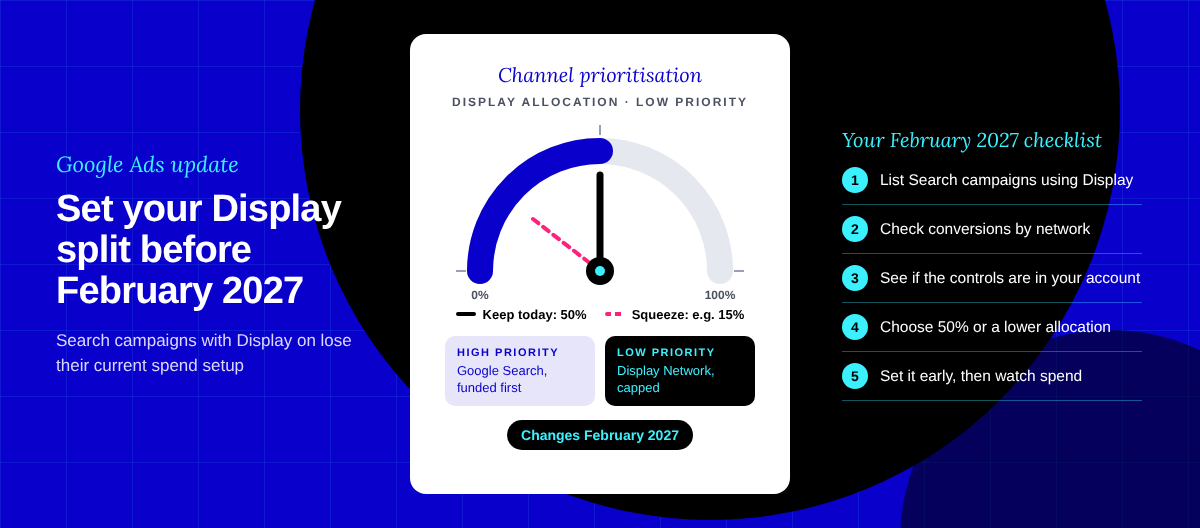
If your Google Ads Search campaign has the Display Network switched on, some of your budget can reach ads across other websites and apps. In February 2027, Google removes the current spend allocation setup. Advertisers “may see a shift in channel spending”. Set your own split before then.
Google announced new channel prioritization and budget allocation controls on 14 October 2026. Here is the decision for Australian advertisers running Search with Display on.
Key takeaways
- Mark channels High or Low priority. High priority channels are funded first.
- Set a percentage allocation for Low priority channels, on a best-effort basis.
- From February 2027, Search campaigns with Display on lose their current spend allocation setup.
- Preserve today’s configuration with Low priority and a 50% allocation for Display, or set a lower allocation.
What Google announced on 14 October 2026
Google introduced two optional controls on its Ads and Commerce Blog, in a post titled “Guide your campaign spending with new priority and allocation features”. They apply across Search, Shopping, Performance Max and Demand Gen campaigns, at account and campaign level, and they also work with shared budgets.
The first is channel prioritisation. You label a channel, or a group of channels, as High priority or Low priority. Google says campaigns will fully fund High priority channels before allocating the remaining budget to Low priority ones. On a Search campaign, that means Google Search, Search partners and the Google Display Network can sit at different priority levels.
The second is budget allocation. Once a channel is set to Low priority, you can set the maximum percentage of your daily budget it is allowed to spend. Read the fine print. Google says its tools will aim to keep spend within that limit “on a best-effort basis”. Treat the percentage as a ceiling Google aims for, not a guarantee.
One nuance for anyone on Target CPA or Target ROAS. Where those campaigns are not limited by budget, Google says prioritisation alone will generally not have an impact. The budget allocation limit is the control that still applies there. If you have not reviewed your targets lately, our piece on the Google Ads Target CPA change is worth reading first.
What changes in February 2027
This is the part with a date on it. Google says that starting in February 2027, “for Search campaigns with the Google Display Network turned on, the current spend allocation setup will go away, and advertisers may see a shift in channel spending.”
To keep the current configuration, Google says to set the Google Display Network to Low priority with a 50% budget allocation.
Google has not said which way spending will shift if you do nothing.
Why local service businesses should care
For many WA service businesses, Display Network inclusion was a setup default rather than a deliberate choice. A plumber wants calls from people searching for a plumber. Display ads reach people browsing other sites and apps. That traffic deserves scrutiny before it gets a larger slice of the budget.
The new controls let you limit display spend rather than turn it off altogether.
For example: a Perth trade business at $100 a day
This scenario is hypothetical and uses only the mechanics Google has published. Picture a Perth plumbing business running one Search campaign on a fixed $100 daily budget, with the Display Network turned on. The owner wants calls and quote requests. Before February, they can choose one of two approaches.
Option one: keep things as they are
Set the Google Display Network to Low priority with a 50% budget allocation, with Google Search at High priority. This is Google’s stated way to keep the current configuration. Search is funded first, and Google aims to keep display spend at or under about $50 of the $100 day, on a best-effort basis.
Choose this if display has produced leads you can trace, or if you have no data either way and want nothing to move while you find out.
Option two: squeeze display back
Set the Display Network to Low priority with a lower allocation, say 15%. Google then aims to keep display spend at or under about $15 a day, again with Search funded first. The intended limit falls from 50% to 15%; actual spending may differ.
Choose this if your conversion data shows display clicks rarely turn into calls or quotes. Check that data before you cut. A cut made without data is still a guess, just a cheaper one.
Doing nothing means accepting an unknown shift in February.
Your February 2027 checklist
- List every Search campaign that has the Google Display Network turned on.
- Look at conversions by network for each one, so you know what display has actually produced.
- Check whether channel prioritisation and budget allocation have reached your account. The rollout is progressive, so the options may not be visible to everyone yet.
- Decide campaign by campaign: Low priority with a 50% allocation to keep current behaviour, or a lower allocation to cut display back.
- Set it well before February 2027, then watch spend by network over the following weeks. Allocation limits are best-effort, so check the result rather than assuming it.
Frequently asked questions
Is channel prioritisation live in my Google Ads account?
Possibly not yet. Google says the controls are rolling out globally over the coming months, so availability varies by account. Check your own account rather than assuming the High and Low priority options are there. When we checked on 26 October 2026, the change had not appeared on the Google Ads announcements page; the Ads and Commerce Blog post is the primary source.
Set the dial before February does
February 2027 is one Christmas break away. The new controls swap an on-off switch for a dial. If you want a second set of eyes on how your Search and display spend splits today, our digital advertising team can help, and our roundup of the best paid media resources is a good place to keep learning.
Set the split yourself. Otherwise February sets it for you.
Sources
- Google Ads and Commerce Blog, “Guide your campaign spending with new priority and allocation features”, Tal Akabas, 14 October 2026.
- Search Engine Journal, “Google Ads Introduces Channel Prioritization And Budget Allocation”, Brooke Osmundson, 14 October 2026.