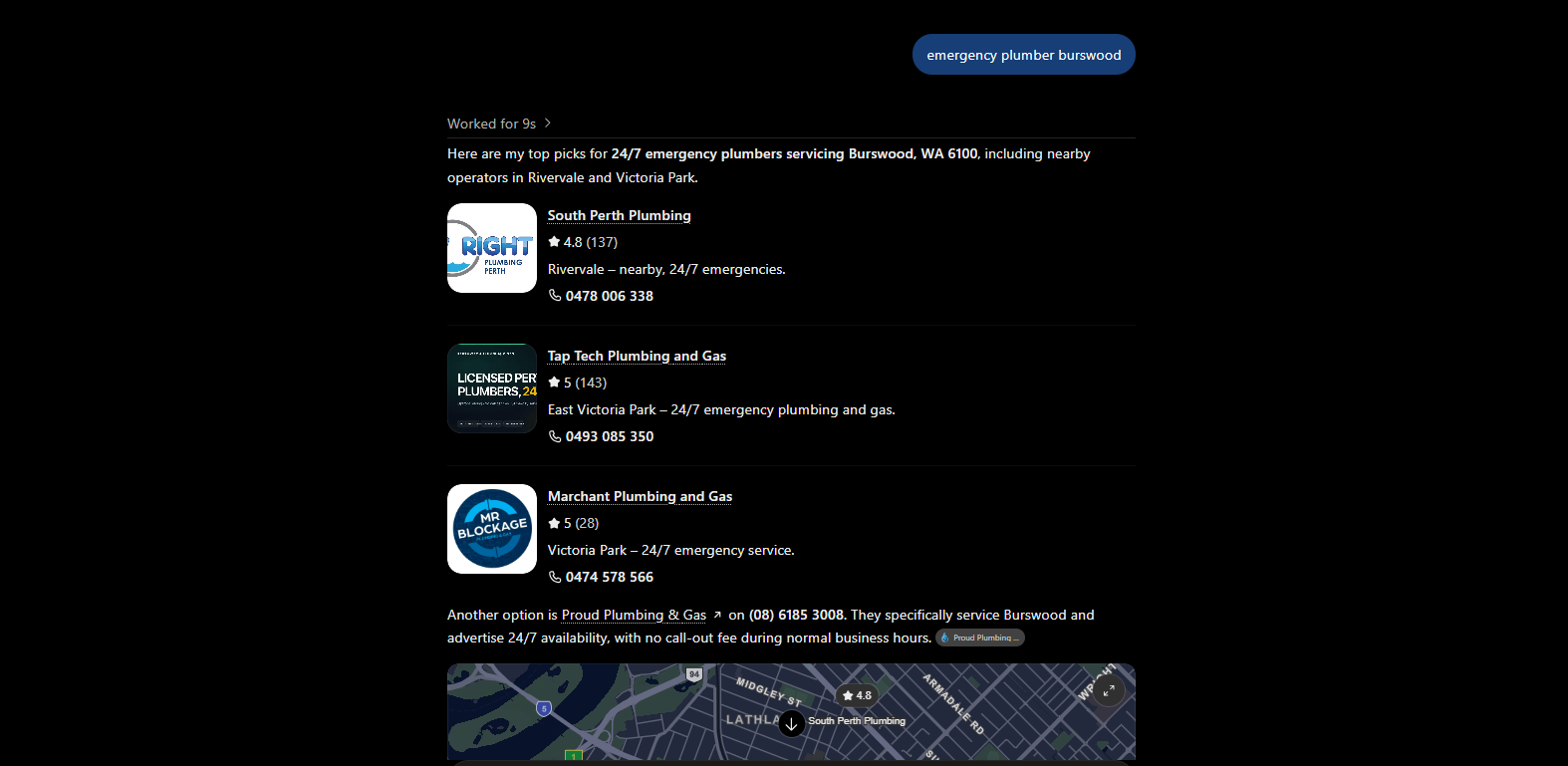
ChatGPT now shows ads, and Australia is one of the live markets. Should your business test it yet? For most small businesses, the honest answer is not yet. The platform is early, the only cross-market data is thin vendor panel data, and the biggest advertiser group so far is B2B software companies, still experimenting. If you run a B2B-leaning business with a lead funnel you can measure, a small, controlled test can be justified as tuition. If you are a local trade or service business spending on Google and Meta, nothing here yet beats doing those two well.
Key takeaways
- ChatGPT Ads is live in Australia, but OpenAI publishes no performance benchmarks for it.
- Australia’s 0.67% figure is pooled panel data from one vendor’s study, not a campaign CTR to plan around.
- Test only with call and form attribution wired first, and a budget you can treat as tuition.
A new channel always arrives with the same itch: get in early or miss out. Early can be cheap. It can also be expensive guesswork, and the difference comes down to what you can measure.
What is ChatGPT Ads, and where does it run?
ChatGPT Ads are paid ads shown inside ChatGPT conversations. OpenAI began testing them in the US on 9 February 2026. On 11 August it said ads had launched in the UK, Mexico, Brazil, Japan and South Korea. On 18 August it announced an expansion to 31 European countries the following week, and by 31 August it put availability at more than 40 countries. On 23 September the rollout reached Indonesia, Malaysia, the Philippines, Singapore, Thailand, Vietnam and Taiwan, taking the total past 60 countries. All of those dates come from OpenAI’s updates, as reported by Search Engine Journal.
That reporting doesn’t give Australia’s start date, but it does confirm Australia is one of the nine live markets in the first cross-market performance dataset.
What does the data say about ChatGPT ads in Australia?
The dataset is “The State of ChatGPT Ads”, a report by Graphite published on 29 September 2026 using Similarweb panel data. It gives each market an all-time click-through rate for users on ChatGPT’s Free and Go plans.
| Market | All-time CTR (Free and Go users) |
|---|---|
| Brazil | 1.91% |
| Mexico | 1.55% |
| Japan | 1.53% |
| South Korea | 1.21% |
| Canada | 0.75% |
| UK | 0.74% |
| US | 0.73% |
| Australia | 0.67% |
| New Zealand | 0.60% |
Source: Graphite and Similarweb, as reported by Search Engine Journal. Each figure pools clicks from every advertiser in that market, so it describes the market, not any one campaign.
In this report, CTR means clicks per ad-bearing exchange (one user message plus a ChatGPT reply that contained an ad), pooled across every advertiser in the market.
Read the fine print before you read the number. Similarweb supplies percentages, not counts, so nobody outside the report knows how many users or replies sit behind Australia’s figure. Markets cover different stretches of time, from five to 25 weeks of data each. Similarweb also sells the ChatGPT ad tracking tool the data comes from. And per Search Engine Journal, OpenAI’s own help centre says ChatGPT Ads currently lack performance benchmarks across advertisers, industries or campaign types.
So 0.67% is not the click-through rate your campaign should expect. Putting it next to your Google Ads CTR compares two different measurements.
Who is advertising on ChatGPT so far?
Software companies lead, and most advertisers are still testing. In the US between 30 March and 4 August, B2B SaaS took 19.9% of ChatGPT ad impressions across 1,210 advertisers, led by Monday.com. Retail and consumer brands came second at 10.4%. Only Jotform and Resume.io stayed in the worldwide top 10 in all 20 weeks measured. Zapier, SAP and The Wall Street Journal rose, then fell away. Graphite describes advertisers as being in “experimentation mode” and says retail and ecommerce have been largely absent, because product feeds didn’t fit the chat format.
The buying options are still forming. Amazon Ads began a pilot letting chosen US advertisers extend Amazon campaigns into ChatGPT on 10 September, and OpenAI named Shopify its first ecommerce partner on 16 September.
What would a proper test take?
Measurement comes first. In a vendor announcement carried by Search Engine Journal, CallRail says its new integration attributes calls, texts and form submissions to specific ChatGPT campaigns and sends conversion data back to OpenAI. Whichever tool you use, the principle holds. If you can’t attribute calls and forms, you aren’t testing. You’re guessing with a credit card.
Then cap the budget. Set a ceiling you could write off, a fixed end date and one question: does ChatGPT produce a qualified lead at a cost close to what Google already delivers? The same controlled posture applies to any budget experiment, as covered in our piece on budget-limited Google Ads campaigns.
For example with Perth businesses:
Both businesses below are hypothetical, written to show the decision. They are not client data.
A Perth B2B services firm has $3,000 a month to test with. Its buyers research suppliers carefully, closer to the software-heavy pattern in the data. A defensible plan: wire call and form attribution first, run for three months at a hard ceiling of $9,000, and judge the result on cost per qualified lead against its Google Ads account. If ChatGPT can’t match Google by the end, the $9,000 bought a clear answer. That is tuition.
A local plumber has $2,000 in total. The data offers no trade-services benchmark and no view of the Australian advertiser mix, so $2,000 buys a few weeks of numbers nobody can judge. The same money inside a well-run Google and Meta setup buys leads the plumber can already track. The plumber should wait, and our digital marketing guide for SMEs covers where that money works hardest.
Should Australian small businesses advertise on ChatGPT in 2026?
Most should not yet. ChatGPT Ads is live in Australia but early, OpenAI publishes no performance benchmarks, and the only cross-market data is vendor panel data. B2B businesses with call and form attribution in place can justify a small, capped test. Local service businesses will get more from Google and Meta today.
The decision rule is short. Test only if all three are true: you sell B2B or a considered purchase, your calls and forms are attributed, and the budget is money you can afford to treat as tuition. Miss any one and wait.
Waiting on the paid side doesn’t mean ignoring ChatGPT. Being cited in ChatGPT answers is a separate, organic job, and it starts with whether ChatGPT can reach your site at all. For channels with the data behind them, see our paid media resources.
The channel will still be there in six months. When the numbers are worth reading, will your tracking be ready to read them?
Sources
- ChatGPT Ad CTR Topped 1% In 4 Markets, Not In The U.S.: Report, Search Engine Journal, 29 September 2026 (reporting Graphite and Similarweb, “The State of ChatGPT Ads”)
- CallRail Makes ChatGPT Ads Measurable For SMBs And Marketing Agencies, Search Engine Journal, 28 September 2026 (news provided by CallRail)