
A customer asks ChatGPT, “Who is the best X in Perth?” Your competitors appear. You do not.
That answer is not fixed by adding “best in Perth” to another page. Your business needs clear facts on its own site, useful passages an AI system can quote, and independent sources that confirm those facts. This guide gives you the playbook: make the answer easy to find, easy to understand and safe to repeat.
There is no switch that guarantees a citation. There is, however, plenty you can do to become a better candidate.
Key takeaways
- Lead each important page with a direct answer that still makes sense when lifted out of context.
- State who the business is, what it does, where it operates and who is responsible for the information.
- Build honest mentions on independent sites because AI answers often cite sources beyond the business’s own domain.
- Publish a connected body of useful content, then track citation patterns across models and prompts.
- Treat every appearance as evidence, not entitlement. AI answers vary and no placement is permanent.
How AI models choose who to cite
AI citation selection comes down to four practical conditions: the system must know about the subject, be able to retrieve a relevant source, understand the entity being discussed, and find enough corroboration to use the claim with confidence.
Some answers draw on patterns learned during training. Others use live or recent retrieval when the model, product and query allow it. That distinction matters. A strong page published today may be available to a retrieval system before it affects any model’s learned patterns. It may also be found by one platform and missed by another.
Entity clarity answers the basic identity questions. Is “Northside Electrical” a registered organisation, a trading name, a location or an article author? Does its address match across the website and major directories? Is the person giving advice clearly connected to the business? Ambiguity makes corroboration harder.
Corroboration is the check outside your own walls. Aleyda Solis analysed 150 top cited-source slots across 15 leading brands in SaaS, ecommerce and finance. External domains accounted for 69.6% to 82.3% of the cited-source mix across those verticals. It was a US-centric, point-in-time study from one analyst and one data provider, so those figures are directional, not a universal benchmark. The useful lesson is simpler: your website cannot do the whole job alone.
Your owned pages establish the facts. Reviews, directories, publishers, industry bodies, marketplaces and community discussions can confirm, compare or challenge them. An AI answer may weigh both, and the mix can change by model, topic and prompt.
Step 1: Make your content quotable
Write one direct, self-contained answer at the start of every page or section that addresses an important customer question.
A quotable passage makes sense without the paragraph above it. It names the subject, answers one question and avoids claims it cannot support. If the answer needs six paragraphs of scene-setting before it becomes useful, the useful part is buried.
Start with the customer’s actual wording. “How much does an emergency electrician cost in Perth?” is stronger than “Understanding electrical service investment” because it matches a real question and promises a recognisable answer. If the price varies, say what changes it. If you cannot publish a fixed number, explain the variables and what the reader should ask for.
Use specific nouns. Repeat the business name when a pronoun would create doubt. Add dates to information that can age. Separate facts from opinions. Link a claim to its source where the source is public and relevant.
Format helps, but formatting is not the strategy. A clean heading, a direct opening sentence and a short supporting explanation give both people and machines less work to do. Our guide to structuring a website for generative search explains how that pattern carries across a full site.
Do not turn the page into a pile of tiny answers. People still need context, judgement and a reason to trust what they are reading. Answer first. Then explain the reason why, show the evidence and cover the exceptions.
Step 2: Make your business legible as an entity
Publish one consistent identity for your business and the people behind its expertise across every page and profile that matters.
An entity is a distinct thing a system can identify, such as an organisation, person, service or place. Your job is to remove avoidable doubt about which thing each fact belongs to.
Begin with a plain About page. State the legal or trading name, the services offered, the areas served, and the relationship between the business and its named people. Give each expert a clear role and a useful profile. If two businesses share a similar name, add enough location and service context to separate yours.
Keep your name, address and phone number consistent across the website and reputable business directories. This is often called NAP consistency. Small presentation differences are normal, but conflicting phone numbers, old addresses and unexplained brand names create needless uncertainty.
Structured data can reinforce those visible facts. Organisation and Person schema should describe what a visitor can already verify on the page. It should not introduce awards, locations, reviews or relationships that the page itself does not support.
Entity statement pattern
Organisation: [Business trading name] is a [business type] serving [specific locations].
Visible identity: The About page states the same name, services, location, phone number and responsible people.
Consistent NAP: The business name, address and phone number match across the website and reputable directories.
Organisation schema: Mark up the visible organisation name, URL, address, phone number and relevant public profiles.
Person schema: Connect each named expert to a visible profile, role and the organisation they represent.
Check the result like a stranger. Could someone identify the organisation, find the responsible person and confirm the contact details from one visit? If not, schema will not rescue the underlying confusion. Labels are useful. Reality comes first.
Step 3: Earn third-party corroboration
Earn accurate mentions on independent sources that your customers and AI systems can verify.
The external-source finding changes the workload. AI search visibility is not only an on-page content job. It also involves public relations, reviews, directory accuracy, professional profiles, community participation and other places where people discuss or compare businesses.
Start with sources that already matter in your category. For a local service business, that may include relevant business directories, trade associations, review platforms, supplier lists and local publications. For software, the useful set may include marketplaces, review sites, technical communities and publisher comparisons. The right source mix depends on the vertical and the platform, so copying another industry’s list is lazy research.
A directory listing should be complete and accurate, not duplicated across fifty sites nobody uses. A press mention should contain a genuine story, useful comment or documented result. A review programme should ask real customers for honest feedback without scripting praise. A community contribution should answer the question instead of dropping a link and running away.
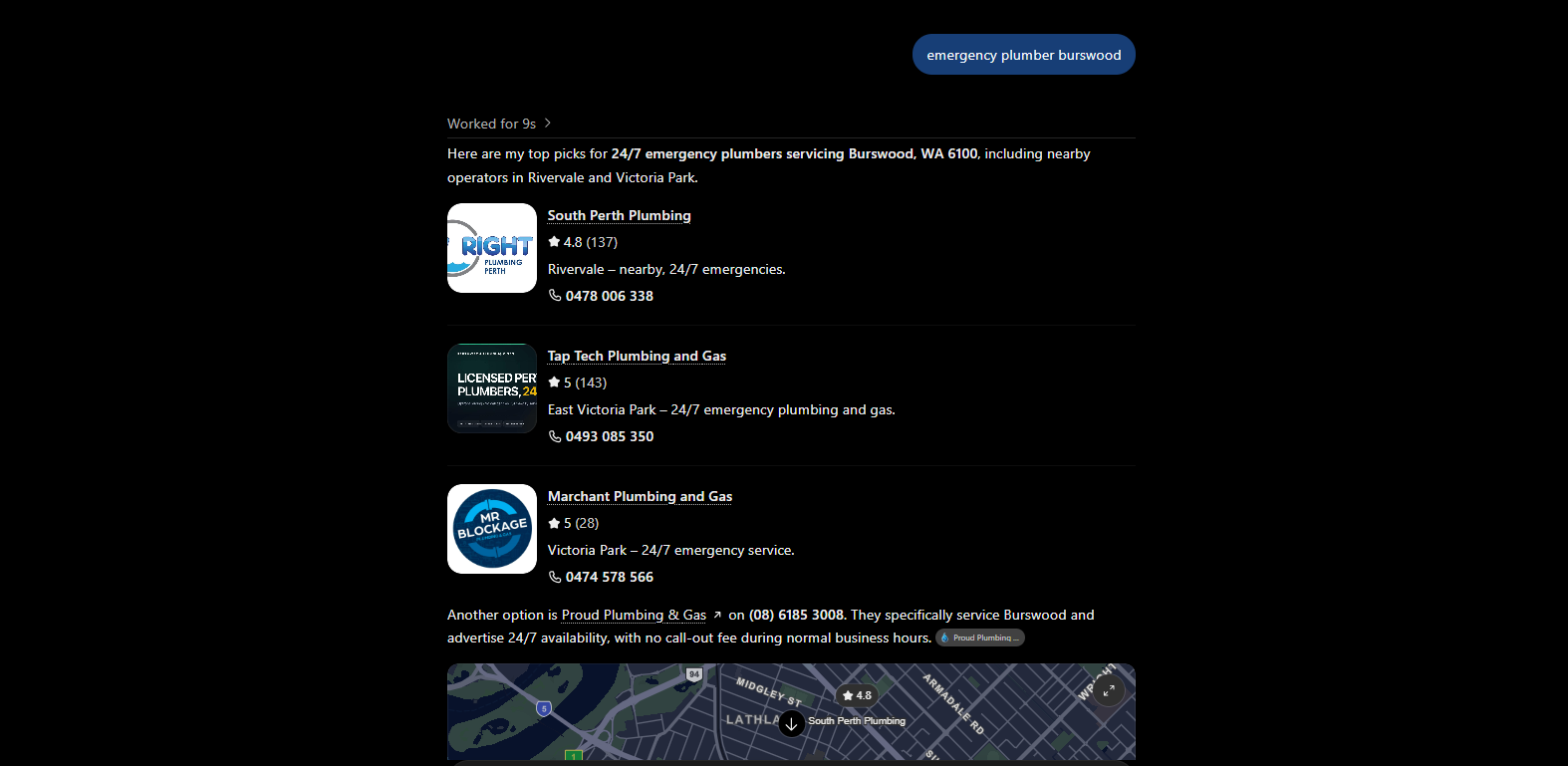
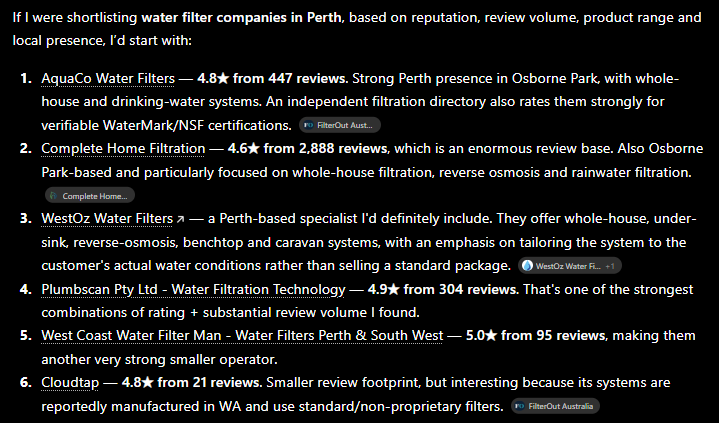
Ask ChatGPT “What are the best water filter companies in Perth?” and WestOz Water Filters appears in the answer, as the screenshot below shows. Part of what puts it there is its Trustpilot profile and 40+ reviews. Review platforms, directories and citation sites give the model independent confirmation that the business exists, operates in Perth and is rated well by real customers.
Keep the claims aligned. If your website says you serve Perth but an old profile says Sydney, fix the old profile. If a publisher uses an outdated business name, ask for a correction. The aim is not perfect repetition. It is a coherent public record.
Independent sources can also disagree with you. That is part of being independently discussed. Do not try to manufacture consensus through fake profiles, planted comments or invented awards. The short-term footprint is not worth the long-term trust problem.
Step 4: Build topical depth, not one-off articles
Build a connected library that answers the next question a customer will ask, not a collection of isolated posts.
One article can answer one query. A useful topic library explains the service, costs, choices, process, risks, examples and common objections around the same subject. Each page has a clear job and links to the next useful page.
Choose topics where your business has something real to add. Aleyda Solis’s content-prioritisation framework separates citation value, brand mention value and business value. It also asks whether the reader still needs to visit after receiving an AI answer. That is a useful filter because citation volume and valuable visits are not the same outcome.
Generic definitions are easy for an AI answer to finish. First-hand case studies, job galleries, current service details, live availability, pricing context and documented methods often give the reader a reason to visit or verify. Our article on what content still works in AI search goes further into that choice.
Map one core topic, then list the questions before and after it. A commercial cleaner might cover scope, pricing, contract terms, quality checks, complaint handling and examples by premises type. An accountant might cover business structure, record keeping, reporting dates and the limits of general guidance. Each answer should point naturally to another, rather than repeat the same introduction with a different suburb pasted in.
Update pages when facts change. Keep useful URLs stable where possible. Remove contradictions. A connected body of work gives people a clearer path through the subject and creates more precise passages that retrieval systems can match to specific questions.
A numbered checklist for AI citation readiness
Use this checklist to turn the playbook into a repeatable monthly review.
- List the exact questions customers ask before choosing your business.
- Give each important question a direct, self-contained answer on the most relevant page.
- Support factual claims with visible evidence, named sources or a clear explanation of how you know.
- State the organisation name, services, locations and responsible people clearly on the About page.
- Match the business name, address and phone number across the website and reputable directories.
- Add Organisation and Person schema only for facts already visible and verifiable on the page.
- Earn accurate mentions, reviews and listings on independent sources that matter in your market.
- Build related pages around one topic and link them according to the customer’s next question.
- Test a fixed prompt set across ChatGPT, Gemini and Perplexity, then record answers and cited sources.
- Correct stale facts, strengthen weak pages and repeat the test without treating one result as a guarantee.
The common mistakes that make citation harder
The most common failure is treating AI visibility as a wording trick when it is really a clarity, evidence and distribution problem.
Publishing vague claims
“Leading”, “trusted” and “best” tell a system very little unless an independent source applies the label using a stated method. Replace empty praise with facts a customer can check: who you serve, what you do, how the process works and what evidence supports the outcome.
Writing for bots instead of customers
Pages stuffed with repetitive questions and awkward phrases may be easy to parse and miserable to read. Human always. Use the customer’s language, answer directly and keep enough context for a sensible decision.
Building only on your own domain
Your site is the factual base, not the entire public record. The 69.6% to 82.3% external-domain range in Solis’s study is not a target percentage, but it is a warning against an owned-only plan. Make earned mentions and relevant directory presence part of the work.
Using schema as a hiding place
Structured data should match visible content. Adding unsupported claims to markup does not make them true. It creates another contradiction to clean up later.
Checking one prompt once
One answer is an anecdote. Prompts, accounts, locations, retrieval modes and model versions can change the result. Use the same tracked query set over time and look for patterns before drawing conclusions.
What success looks like
Success is a stronger, more consistent evidence trail that improves your chance of being named or cited for relevant questions.
You should be able to see direct answers on your important pages, consistent entity details across trusted profiles, useful independent mentions and a growing set of citations in your tracking log. You should also know which queries produce no citation, which competitors recur and which sources the models prefer.
That last part matters. A citation with no commercial relevance is not automatically useful, and a valuable visit can come from a page that is rarely cited. Track citation value, brand mention value and business value separately. If you want the wider technical and content foundation, use this guide to prepare your website for AI search.
What you cannot control
You cannot control whether a model includes your business, which source it selects, how it phrases the answer or whether the same prompt produces the same result tomorrow.
AI outputs are probabilistic. Models differ in training data, retrieval access, source preferences, safety rules and answer construction. The user can also change the context by adding a location, budget, requirement or follow-up question. A source that appears in Perplexity may not appear in Gemini. ChatGPT may answer differently across products or retrieval settings.
No ethical agency can guarantee placement in an organic AI answer. Anyone selling certainty here is selling the one thing the system does not offer.
Control the inputs you own: accurate pages, useful answers, clear entities, public proof and honest tracking. Then accept variance as part of the channel, not proof that the work failed.
Frequently asked questions
Can I pay to appear in ChatGPT?
You cannot buy a guaranteed organic citation in the answer types covered by this guide. A platform may offer paid placements, but advertising and earned citation are different. Treat any promise of guaranteed organic inclusion with caution and ask exactly which product, placement and reporting method the seller means.
How long does it take to get cited by AI models?
There is no reliable fixed timeframe. Results depend on when sources are published, discovered or retrieved, how clearly the entity is described, whether independent corroboration exists and which model answers the query. Track a fixed prompt set at regular intervals rather than promising a date.
Do I need different content for ChatGPT, Gemini and Perplexity?
Build one accurate factual base first. Clear answers, consistent entity details and credible corroboration help across platforms, even though each model may retrieve and cite differently. Test each platform separately, then improve gaps in the shared source material instead of creating three contradictory versions of the truth.
How do I track AI citations?
Create a fixed list of commercial and informational prompts. For every test, record the date, model or product, exact prompt, answer, cited URLs, named businesses and relevant context such as location. Repeat the test consistently. Measure recurring patterns, not a single flattering screenshot.
Build the record worth citing
Getting cited by ChatGPT, Gemini or Perplexity starts well before the prompt. It starts with a business that explains itself clearly, publishes answers worth quoting and gives independent sources something truthful to confirm.
Do that work and you improve the odds without pretending you control the outcome. The question is not whether an AI model owes you a mention. It is whether the public record gives it a good enough reason to choose you. What would you make clearer first?
Sources
- Aleyda Solis, “AI Search Is a 3rd-Party Citation Problem With an On-Page Corroboration Base”, published 2 August 2026, retrieved 2026-08-11: https://www.aleydasolis.com/en/ai-search/ai-search-citations/
- Cate Dombrowski, iPullRank, “What 13 Billion Google Searches Reveal About Zero-Click Behavior”, published 30 July 2026, retrieved 2026-08-11: https://ipullrank.com/zero-click-behavior-analysis-q3-2026
- Aleyda Solis, “Content Prioritization in an AI Search Era: A Framework + Worksheet”, published 6 August 2026, retrieved 2026-08-11: https://www.aleydasolis.com/en/ai-search/content-prioritization-ai-search/