Most Perth businesses asking about AI search visibility have the same problem.
Their website exists. It ranks. It has pages. But when Google’s AI, ChatGPT, or Perplexity looks at it, the site reads like a locked filing cabinet. The information is in there somewhere. The AI just can’t find it fast enough to bother citing it.
That’s not a content problem. It’s a structure problem.
This article goes through your website room by room; homepage, service pages, location pages, blog, FAQ… and tells you exactly what generative AI needs to find on each one to pull your business into its answers.
No jargon. No five-point checklists that apply to everyone and help no one. Just a practical blueprint you can start using this week.
What generative search actually reads
Google’s AI Overviews, ChatGPT, Perplexity, and Google’s newer AI Mode all pull from the same type of content. They are not reading your website the way a human does. They are scanning for clear signals: who you are, what you do, where you do it, why you are trustworthy, and whether you can answer the question being asked in plain language.
If those signals are buried in dense paragraphs, hidden behind generic service descriptions, or simply absent from your pages, the AI skips you. It finds a competitor whose site is easier to read and cites them instead.
The businesses that consistently appear in AI-generated answers share one thing: their websites are structured to answer questions, not just describe services.
Here’s what that looks like in practice.
Your homepage: tell the AI who you are in the first paragraph
Most homepages open with a tagline. Something like: “Perth’s most trusted marketing agency” or “Building better businesses since 2010.”
Generative AI does not cite taglines. It cites answers.
Your homepage needs a clear, factual opening paragraph that tells any AI system exactly what your business does, who it serves, and where it operates. Not a slogan. A statement.
Something like: “Optimise Online is a Perth-based digital marketing agency that helps trade, professional services, and eCommerce businesses build websites and marketing systems that generate qualified leads.”
That one sentence answers four questions the AI is scanning for: what type of business, what service, what location, who the customer is. A tagline answers none of them.
While you are on the homepage, check two other things. First, is your business name, address, and phone number (NAP) consistent with what appears on your Google Business Profile and every directory listing? Inconsistent NAP data creates trust gaps AI notices. Second, do you have an Organisation or LocalBusiness schema block implemented? If not, Google’s AI has to guess what your business is rather than read a clear declaration.
Learn more about our SEO Services and how we can help you.
Your service pages: answer before you describe
This is where most websites lose the AI citation entirely.
A typical service page looks like this: a heading with the service name, two paragraphs about why the service matters, a list of features, and a call to action. That structure is designed to sell. It is not designed to be cited.
Generative AI needs something different. It needs the answer to the question people are actually typing, and it needs that answer near the top of the page, not buried at the end.
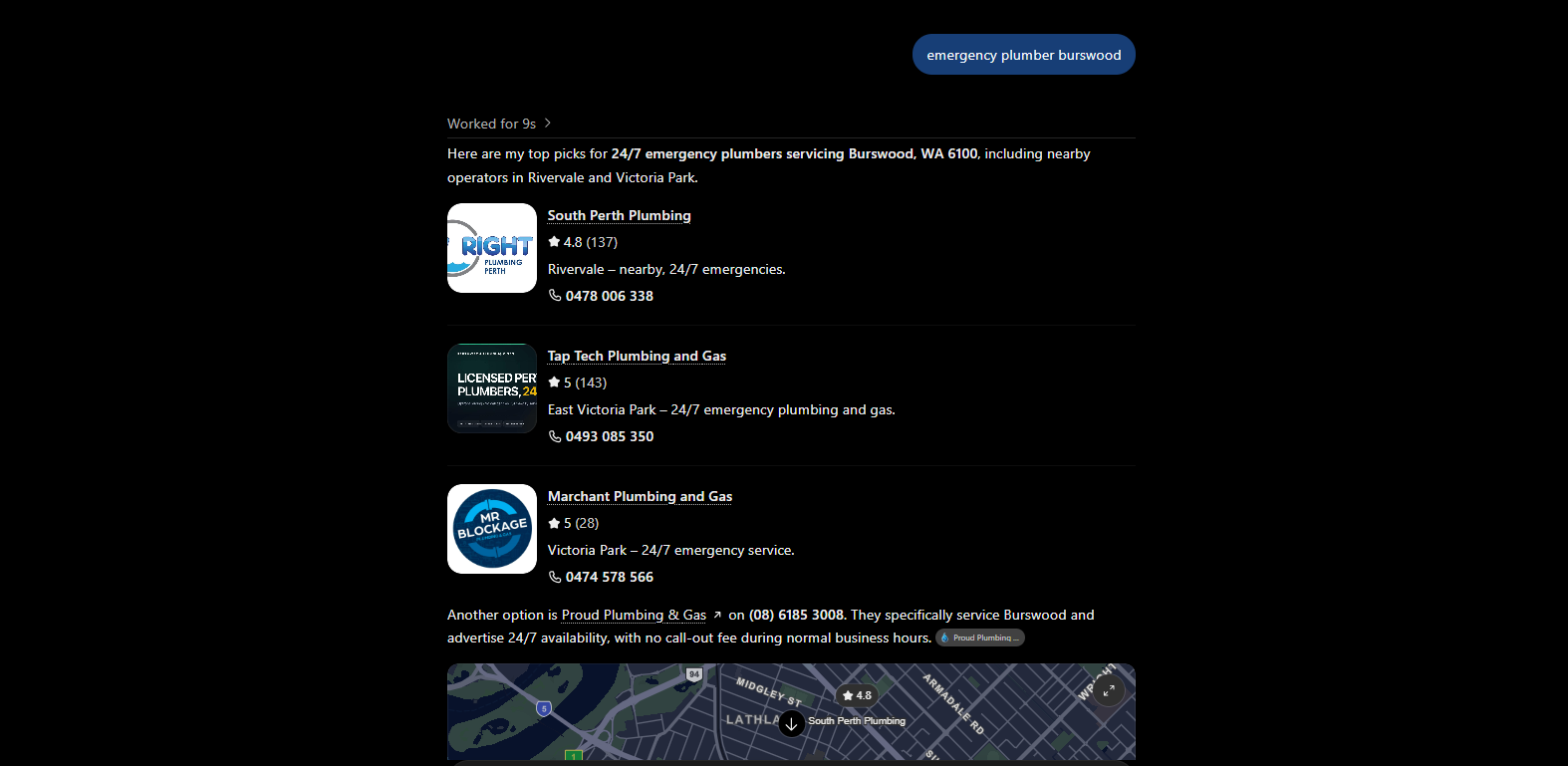
If you run a plumbing business and someone asks Google “how much does a hot water system installation cost in Perth?”, the AI will cite the plumber whose service page opens with a direct, specific answer to that question. Not the one whose page says “Our team of experienced plumbers delivers quality results across the Perth metro area.”
The fix is straightforward. For each service page, identify the one or two questions your customers ask most often before booking. Write a direct answer to each one in two to four sentences. Put those answers near the top of the page, under a question-formatted heading.
That heading structure matters. “How much does hot water system installation cost?” performs in generative search. “Our Pricing” does not.
Then go deeper. Add a section that explains the process step by step. Add specific detail: how long the job typically takes, what the customer needs to prepare, what can affect the final cost. Specificity is what separates a cited source from an ignored one.
Learn more about our Website Design Services, and how we can help you.
Your location pages: local context is an AI trust signal
If you serve multiple areas, you likely have location pages. Most of those pages are thin. They have the suburb name in the heading, one paragraph of generic copy with the location name swapped in, and a contact form.
That structure does not work for generative search. AI systems treat thin, templated location pages as low-trust content. They look for location pages that demonstrate genuine local knowledge and specific service information.
A location page that generative AI will cite has three things a templated page does not.
First, it references local context that only a business actually operating in that area would know. Not “we serve Joondalup” but “we work with residential and commercial clients across Joondalup, including estates in Iluka and Kinross where newer builds often require upgraded switchboard capacity.”
Second, it addresses the specific service questions people ask in that area. A Perth electrician’s Joondalup page should answer questions specific to that suburb’s typical property types and common electrical issues, not just repeat the content from the Fremantle page with the suburb name changed.
Third, it links to Google reviews from customers in that area. AI citation decisions factor in local trust signals. A location page backed by reviews from identifiable local customers reads as more credible than one that isn’t.
If you have 15 thin location pages, prioritising your top three or four suburbs and building them out properly will outperform keeping all 15 in their current state.
Your blog: structure for extraction, not just reading
Blog posts are one of the highest-yield pages for generative search citation, if they are structured correctly.
The structural error most businesses make is writing blog posts as continuous essays. One topic flows into the next. There are no clear section breaks. The key information is distributed through the piece rather than isolated.
AI cannot extract a citation from a flowing essay as reliably as it can from a well-sectioned piece with clear headings and standalone answer paragraphs.
The structure that performs in generative search looks like this: a direct answer to the article’s core question in the first two paragraphs, then a series of H2 sections each addressing a related sub-question, with each section opening with a one to two sentence answer before expanding into detail. This is sometimes called the “answer first” structure, and it mirrors exactly how AI systems extract quotable content.
The other change worth making: add a “What to remember” or summary section at the end of longer posts. AI systems regularly pull from conclusion paragraphs that condense the article’s key points. A one-paragraph summary at the end of a 1,500-word post significantly increases the chance of that post being cited.
Finally, check that every blog post has an author name attached and that author has a bio page or at minimum a bio paragraph. Authorless content carries lower trust weight in AI citation decisions than content attributed to a named, credentialed person.
Your FAQ page: the most underused AI citation asset on any website
No page type performs better in generative search than a well-built FAQ page.
The reason is simple: FAQ pages are already structured in the question-and-answer format that AI systems are scanning for everywhere else. A good FAQ page does not need to be decoded. It just needs to be read.
Most business FAQ pages are short, generic, and rarely updated. They answer questions like “How do I contact you?” and “Do you offer a guarantee?” Those questions are useful for customers but they are not the questions driving generative search citations.
The FAQ pages that get cited answer the questions people type into Google, ChatGPT, and Perplexity before they decide who to hire. For a Perth accountant, that might be: “How much does a tax return cost for a small business in Perth?” or “What’s the difference between a bookkeeper and an accountant?” or “Do I need an accountant if I use Xero?”
Each answer should be two to four sentences. Long enough to be useful. Short enough for AI to extract without editing. And each answer should be self-contained, it should make sense read in isolation, because that is exactly how AI will use it.
Once you have the content right, implement FAQPage schema markup. This is the structured data code that tells Google’s crawler “this section is a FAQ, these are the questions, these are the answers.” Without it, the AI has to infer the structure. With it, the AI has a clear map.
If you have service pages, location pages, and a blog, consider adding a short FAQ section to each of those pages as well. Every page that carries question-and-answer content in a clear format is a potential citation point.
Internal linking: the signal most businesses ignore
Internal links are not just navigation. For generative AI, the pattern of links across your website is a map of what your business considers important.
A website where every service page, blog post, and location page links back to a central hub page on that topic sends a clear signal: this business has depth and authority on this subject. A website where pages exist in isolation; no links in, no links out, reads as a collection of disconnected documents rather than a coherent knowledge base.
The fix does not require a technical overhaul. It requires a review of your highest-value pages and a deliberate decision to link related content together.
Every blog post that mentions a service you offer should link to that service page. Every service page should link to relevant blog posts and FAQs. Every location page should link to the service pages most relevant to that area. If you have written about a topic from three different angles across three different posts, those posts should reference each other.
This is the website structure that AI reads as authority. Not a single great page. A network of connected, credible content pointing to itself.
The Foundation check: before you restructure anything
Content structure changes will not move the needle if your technical foundation is broken.
Before restructuring any page for generative search, check these four things. If any of them fail, fix them first.
Page speed: run your site through Google PageSpeed Insights. A slow website is crawled less thoroughly, which means AI systems see less of your content. Aim for a score above 70 on mobile.
Mobile rendering: open your service pages and FAQ on a phone. If text is hard to read, sections are collapsed, or the layout breaks, that is a crawlability issue that affects AI citation regardless of how good your content is.
Indexation: search Google for site:yourdomain.com.au. If the number of indexed pages is significantly lower than the number of pages on your site, Google is not seeing all your content. Pages that aren’t indexed can’t be cited.
Google Business Profile: for local Perth businesses, your GBP is a trust anchor that AI Overviews factor into local citation decisions. If it is incomplete, unclaimed, or hasn’t been updated in months, fix that before anything else.
Frequently asked questions
What is generative search?
Generative search refers to AI-powered search experiences that generate direct answers rather than returning a list of links. This includes Google AI Overviews, Google AI Mode, ChatGPT search, and Perplexity. Instead of directing users to websites, these tools synthesise content from multiple sources and present a composed answer, sometimes citing the sources used.
Does website structure really affect whether I appear in AI-generated answers?
Yes. AI systems extract content from web pages more reliably when that content is clearly structured. Pages with question-based headings, direct answer paragraphs, and FAQPage schema give AI a clear map of what the page covers. Unstructured content in dense blocks is harder for AI to parse and is more likely to be skipped in favour of a competitor’s more readable page.
How quickly can website structure changes affect AI visibility?
Research from Australian SEO practitioners suggests technical citation wins from content restructuring can appear in AI search results within 3 to 8 weeks. This is faster than traditional ranking changes, because AI systems re-index and re-evaluate content more frequently than traditional ranking algorithms update position.
Do I need to rebuild my website to optimise for generative search?
No. Most generative search optimisation work involves restructuring existing pages, not rebuilding the site. The highest-impact changes, rewriting service page openings to lead with direct answers, adding question-based headings, building out FAQ sections, and adding schema markup, can be made to existing pages without a rebuild.
What is schema markup and does my website need it?
Schema markup is structured data code added to your website that tells search engines and AI systems what type of content is on each page. FAQPage schema tells Google that a section contains questions and answers. LocalBusiness schema tells it your business name, address, phone number, and service area. Organisation schema describes your brand entity. Without schema, AI systems have to infer this information from your content. With it, they have a clear, machine-readable declaration. Most Perth business websites are missing at least one relevant schema type.
Is optimising for Google AI Overviews the same as optimising for ChatGPT?
The structural principles are the same. Both reward direct answers, clear headings, credible authorship, and question-formatted content. The main difference is that Google AI Overviews draw heavily from indexed web content and are influenced by traditional SEO signals like backlinks and GBP data. ChatGPT and Perplexity have their own crawlers and weight brand mentions and citations from third-party sources more heavily. Optimising your website structure as described in this article addresses both.
What to do first
You do not need to restructure every page at once.
Start with the page on your website that drives the most enquiries. Open it, read the first two paragraphs out loud, and ask one question: if someone typed the core topic of this page into Google, does this page open with a direct answer to that search?
If it doesn’t, that’s your first fix. Rewrite the opening. Add a question-formatted heading above it. Make it impossible for an AI to misread what this page is about or who it is for.
Then do the same for your second-highest-value page. Then your FAQ. Then your blog.
Structure is not the only thing that determines AI citation. But it is the thing most Perth business websites get wrong, and it is the thing most within your control to fix.
Optimise Online helps Perth businesses build websites that AI search can read, trust, and cite. If you want to know how your site stacks up, get in touch.