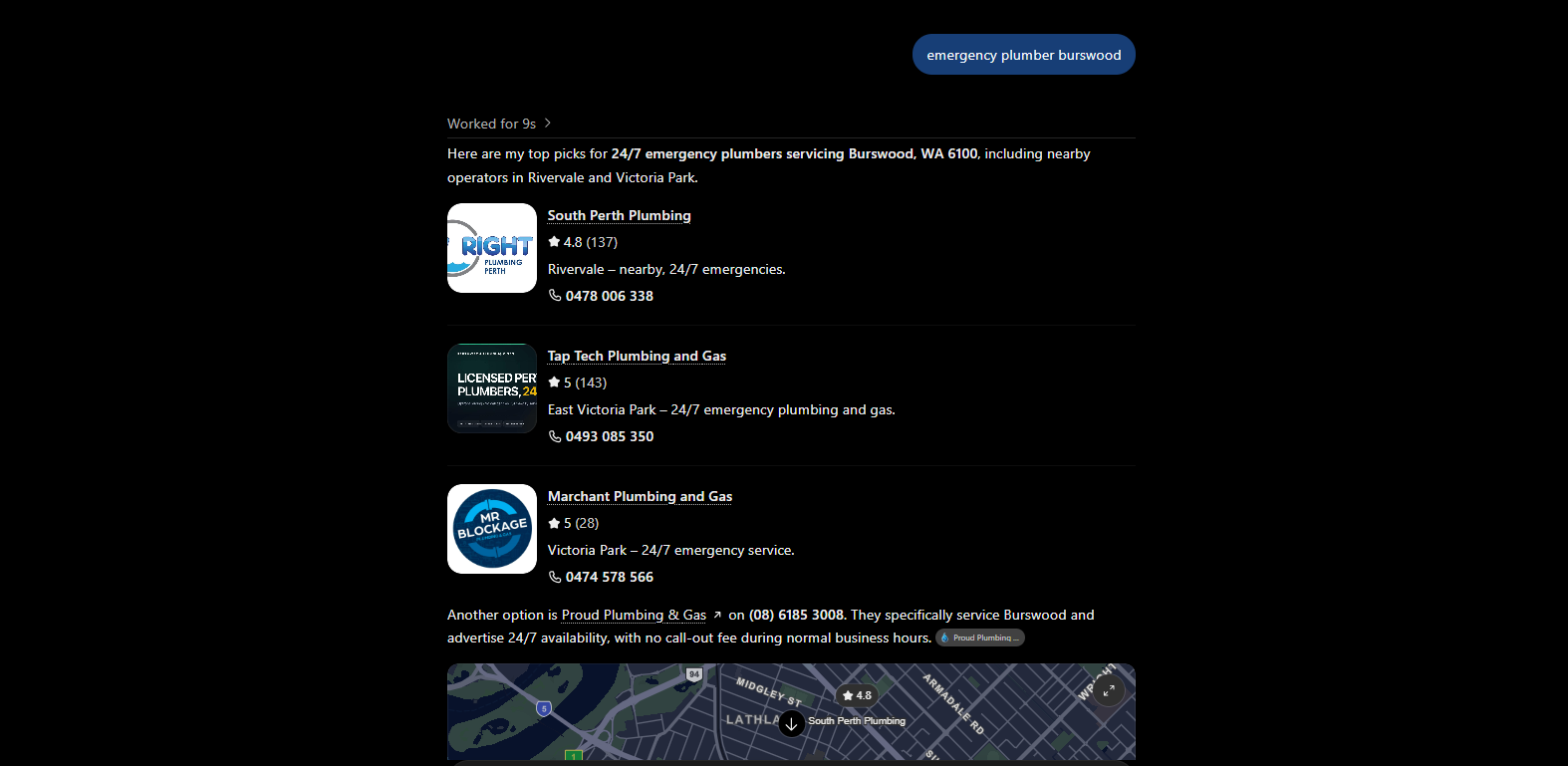

Your website might be ranking on Google. Your Google Business Profile might be ticking along. But right now, a Perth homeowner is typing into ChatGPT: “Who’s the best plumber near me?” And if your business isn’t in the answer, it doesn’t matter how good your SEO is. You simply don’t exist to that customer.
This is the shift happening in search. It’s not a distant threat. It’s already affecting how trades businesses win or lose jobs. This article explains what AI search is, why it matters specifically for trade businesses in Perth and across Australia, and what you need to do about it.
What AI search actually is (and how it’s different)
Traditional search gave you a list of links. You clicked one, landed on a website, and made a decision from there. AI search doesn’t do that.
Tools like ChatGPT, Google’s AI Overviews, and Perplexity read the question, synthesise information from across the web, and give a direct answer. No list of links. No scrolling. Often, no click required at all.
This matters for your trades business because more than 58% of Google searches are now “zero-click searches” — meaning the user gets their answer without visiting any website. That number is growing, not shrinking.
And it’s not just Google. ChatGPT handles over one billion queries per month. Younger homeowners between 25 and 45 are increasingly turning to AI tools first when they need a tradie. They’re not asking for a list of websites. They’re asking for a name they can trust.
The question is whether your name comes up.
Check out our SEO Services, and learn how we can help you be more visable online.
Why this hits trades businesses harder than most
A law firm or an accountant can build a reputation on referrals, branded search, and long-term client relationships. Tradies are different. A large portion of your work comes from people who’ve never heard of you. They have a problem today. They need someone fast. And they’re asking whatever tool is closest.
That used to mean Googling “plumber near me” and clicking the top result. Now it means asking an AI tool and going with whoever the system recommends.
Here’s what makes this uncomfortable: the AI doesn’t send you a notification when it recommends someone else. It just does it. Quietly. And you lose the job without knowing it was ever on offer.
The zero-click problem in plain terms
Imagine a homeowner in Subiaco needs an emergency electrician on a Saturday morning. They open ChatGPT and type: “Who’s a licensed electrician in Subiaco I can trust?”
The AI scans reviews, your website content, your Google Business Profile, trade directories, and social mentions. Within seconds, it returns two or three names. The homeowner picks one and rings them. Your business might rank number one on Google. But if the AI didn’t cite you, that job went elsewhere. The person never Googled anything.
This is not a future problem. Google launched AI Overviews in Australia in October 2024. By mid-2025, they were appearing in up to 39% of Australian searches. Research from Ahrefs shows that when an AI Overview appears, the click-through rate for the number-one organic result drops by 34.5%.
Your Google Ads spend doesn’t protect you from this. Paid ads appear in a different part of the results page, and many AI-generated answers bypass them entirely.
How AI decides which tradie to recommend
This is the part most articles skip. They tell you to “optimise for AI search” without explaining what the AI is actually looking for. Here’s a direct answer.
AI tools are not scanning websites for keywords. They are making trust decisions. They ask, in effect: is this a real, credible business? Does it have a track record? Does the web confirm what this business says about itself?
Four signals carry the most weight:
- Reviews, volume and recency. A business with 80 Google reviews averaging 4.8 stars, with the most recent posted two weeks ago, looks credible to an AI. A business with 12 reviews from three years ago does not. A 2024 BrightLocal study found that 87% of Australians read online reviews before hiring a local service. AI tools weight this the same way.
- Consistent business information across platforms. Your business name, address, and phone number need to be identical across Google, your website, Facebook, trade directories, and anywhere else you appear. Even a small mismatch, say “Pty Ltd” on one listing and nothing on another, reduces the AI’s confidence that your business is real and active.
- Website content that answers real questions. AI tools pull answers from structured, clear content. If your website has a page that directly answers “how much does an emergency plumber cost in Perth?” or “how long does a switchboard upgrade take?”, those pages become citation candidates. A five-page brochure site with no FAQ content is invisible to AI.
- An active, complete Google Business Profile. Google’s AI features draw heavily from GBP data. Businesses with a complete, active profile get seven times more clicks than bare-bones listings. That multiplier applies whether the person found you through traditional search or through an AI Overview.
Notice what’s not on this list: the number of blog posts you’ve published, how many Instagram followers you have, or how slick your website looks. AI search is built on trust signals, not vanity metrics.
What good looks like: a tale of two electricians
Let’s say two electricians both service the southern suburbs of Perth. Both have been operating for eight years. Neither is spending on Google Ads right now.
Electrician A has 11 Google reviews (last one nine months ago), a basic Google Business Profile with no photos, and a website that lists their services with no content beyond that. Their name, address and phone number don’t appear anywhere except Google and Facebook.
Electrician B has 64 Google reviews averaging 4.9 stars, with four posted in the last month. Their Google Business Profile has 22 photos, lists 11 specific services, and includes their service areas by suburb. Their website has a FAQ section answering 14 common customer questions. They appear in three local trade directories with identical business details.
When a homeowner in Canning Vale asks ChatGPT for a trusted electrician, Electrician B gets recommended. Electrician A doesn’t come up. This isn’t unfair. It’s the AI doing exactly what it’s supposed to do: surface the most trustworthy, verifiable option.
The gap between those two electricians isn’t talent or quality of work. It’s Foundation.
The three things to fix first
You don’t need to overhaul everything at once. AI search readiness follows the same logic as good marketing: build the foundation right, then amplify. Here’s where to start.
1. Audit your AI visibility right now
Open ChatGPT or Perplexity. Type in the questions your customers ask. “Best electrician in [your suburb].” “Who does commercial plumbing in Perth’s northern suburbs?” “Trusted builder for home extensions in Fremantle.” See what comes back. If your business isn’t appearing, you now know where you stand. That’s your starting point, not a reason to panic.
2. Lock down your Google Business Profile
Claim and verify it if you haven’t. Add your specific primary category (not just “Contractor”, use “Electrician” or “Plumber”). List every service you offer. Add photos of your team and your work. Include your service areas by suburb. Set up a process to ask every satisfied customer for a Google review within 24 hours of completing the job. Consistent review volume matters more than a single burst.
3. Add structured FAQ content to your website
Think about the ten questions your customers ask most often before they book. “How much does a blocked drain cost to clear?” “Do you offer after-hours call-outs?” “How long does a hot water system replacement take?” Put those questions and direct, specific answers on your website. Each answer should be two to four sentences. That’s the format AI tools pull from when building their responses.
These three steps won’t take months. A business owner who’s serious about it can get the foundation right in a few weeks. The businesses doing this now are building an advantage that compounds. The ones waiting are simply handing jobs to competitors who got started earlier.
Looking for help with Website Design? Check out our services and explore how we can help.
Does traditional SEO still matter?
Yes. Emphatically. Google still processes billions of searches every day, and in Australia it holds around 93% of search market share. Local search results and map packs remain resilient even as AI Overviews grow.
The right way to think about it: AI search and traditional SEO feed the same foundation. A business with strong local SEO, consistent listings, good reviews, and clear website content will perform well in both. They aren’t competing strategies. The work you do to rank well in local search is the same work that gets you cited by AI.
What changes is urgency. Gartner predicts traditional search volume will drop 25% by the end of 2026 as AI chatbots take a larger share of queries. Businesses that only focus on traditional SEO now and plan to adapt later are operating on borrowed time.
Frequently asked questions
What is AI search?
AI search refers to tools like ChatGPT, Google’s AI Overviews, and Perplexity that answer questions directly rather than returning a list of links. Instead of showing ten results for a query, they synthesise information from multiple sources and give a single, direct response. For local searches, this often means recommending a specific business rather than a list of options.
Will AI search replace Google for tradies?
Not entirely, and not soon. Google still dominates Australian search with around 93% market share. But the way Google delivers results is changing, with AI Overviews now appearing in a significant portion of queries. The practical answer is that tradies need to be visible in both traditional search and AI-driven answers. The underlying work to achieve both is largely the same.
How does AI decide which tradie to recommend?
AI tools make trust decisions based on the information available about your business across the web. Key factors include the volume and recency of your Google reviews, whether your business information is consistent across all platforms, whether your website answers common customer questions clearly, and the completeness of your Google Business Profile. Strong performance across all four gives AI tools confidence to recommend you.
Does my Google Ads spend protect me from this shift?
No. Google Ads appear in the paid section of search results, which is separate from AI Overviews and not factored into AI chatbot recommendations. A tradie can be spending heavily on ads and still be invisible to customers using AI tools to find services. Paid advertising and AI search visibility are separate problems requiring separate strategies.
How do I know if AI search is already affecting my business?
The simplest test is to open ChatGPT or Perplexity and ask the questions your customers ask. “Best plumber in [your suburb].” “Who does emergency electrical work in Perth?” If your business doesn’t appear, you are not being recommended to customers using those tools. You can also check your Google Search Console data for changes in organic click-through rate, which may indicate AI Overviews are appearing above your results.
What is the first thing a Perth tradie should fix?
Start with your Google Business Profile. Claim it, complete every section, add photos, list your specific services, and set your service areas by suburb. Then build a simple review request system so customers hear from you within 24 hours of a completed job. These two steps, done properly, will produce the fastest visible improvement in your AI search presence.
The shift is happening. The question is whether you’re ready.
AI search isn’t replacing Google overnight. But it is quietly changing who gets recommended to customers who are ready to book today. For trades businesses, the opportunity is real: this is still early, competition for AI visibility is low, and the businesses that build strong foundations now will be the ones cited by default.
The work isn’t complex. It starts with getting the basics right: reviews, a complete Google Business Profile, consistent information, and website content that answers real questions. That’s the foundation. Everything else builds from there.
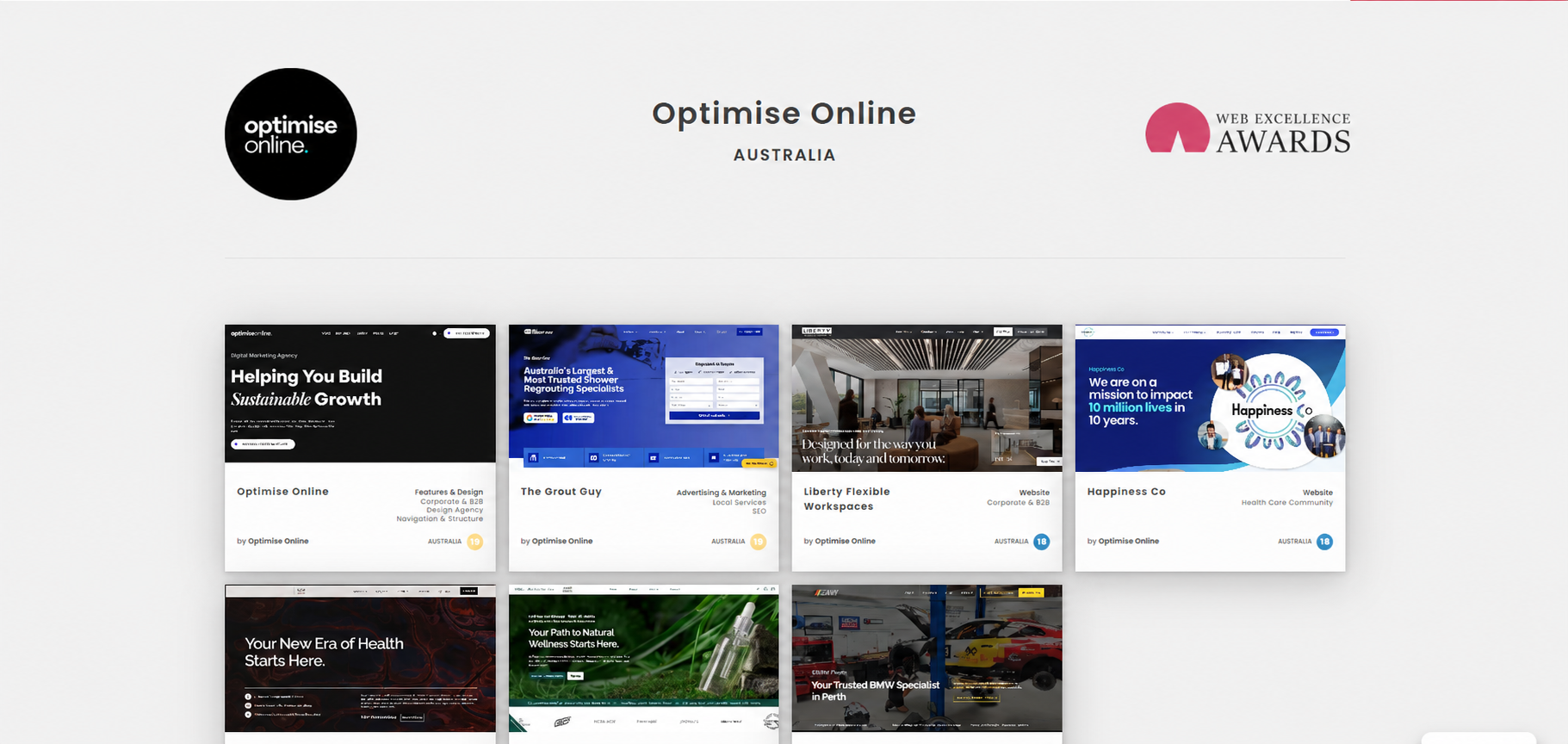
Optimise Online works with trade and construction businesses across Perth. Get in touch to see how we can help you win better jobs.