
Search has changed faster in the last 18 months than it did in the previous decade.
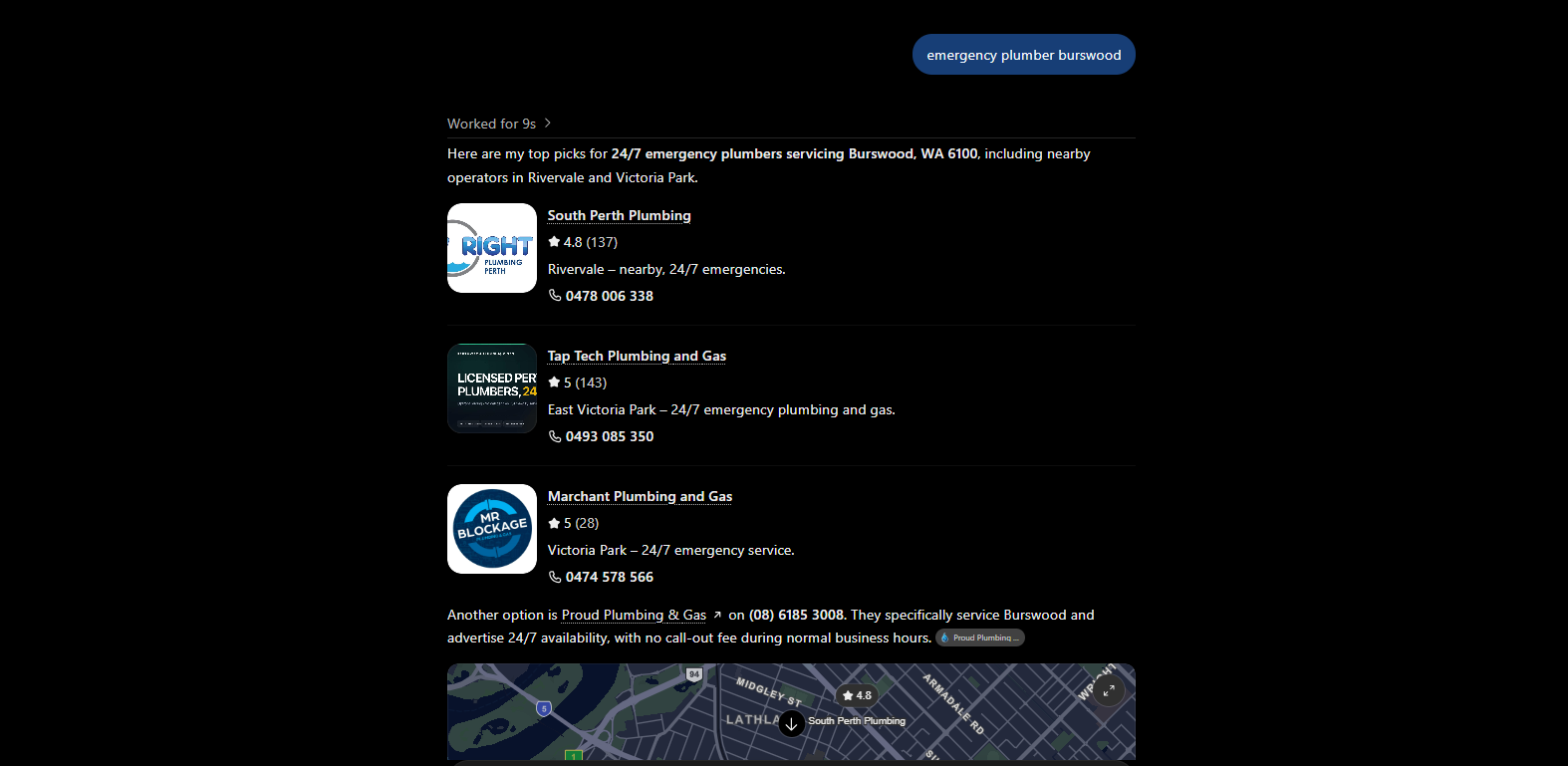
Google now summarises answers before you see a single link. ChatGPT recommends specific businesses by name. Perplexity cites sources like a research assistant. And when someone asks “what pool fencing company should I consider in Perth,” the AI doesn’t show a list of websites. It names one.
If your business isn’t being named, you’re invisible to a growing share of your potential customers.
This guide explains exactly how to optimise your website for AI search, what’s actually working in 2026, and where most businesses are getting it wrong.
What AI search actually does (and why it’s different)
Traditional SEO was about ranking pages. You targeted a keyword, built content, earned links, and climbed the results page.
AI search doesn’t return a ranked list. It reads your content, evaluates your credibility, and synthesises an answer. The user gets a response, not a set of blue links.
Google AI Overviews, ChatGPT, and other generative engines now:
- Summarise content
- Pull structured answers
- Compare businesses
- Recommend services
- Answer conversational queries
As of early 2026, Google AI Overviews appear in approximately 25% to 39% of all Google searches, with some studies suggesting they appear in up to 55% of searches depending on the device and query type. They are most common in long-tail informational queries (7+ words), where they appear in over 46% of cases.
The businesses appearing in those answers aren’t getting there by accident. They’ve structured their websites so AI engines can understand what they do, who they serve, and why they’re credible.
Instead of:
“Best digital marketing agency Perth”
Users now ask:
“Who is the best digital marketing agency in Perth for a $3M construction business?”
AI search responds with synthesised answers.
If your site is vague, generic, or poorly organised, AI has nothing concrete to work with. It moves on to a competitor who made it easier.
What is AEO and why do you keep seeing different acronyms?
You’ll come across several terms: AEO, GEO, LLMO, AI SEO. They all describe the same underlying goal: making your content easy for AI systems to find, understand, and reference.
- AEO (Answer Engine Optimisation): Focuses on structuring content so AI systems select it as the answer to a specific question.
- GEO (Generative Engine Optimisation): The broader practice of optimising for generative AI tools like ChatGPT and Gemini.
- LLMO (Large Language Model Optimisation): The technical term for the same thing, used more in developer and enterprise contexts.
Instead of trying to rank pages for keywords, focus on making your content easy for AI tools to extract and reference.
This means your content should:
- Answer real questions clearly
- Provide direct explanations
- Use structured headings
- Include FAQ sections
- Avoid vague marketing language
For example, if someone asks:
“How do I optimise my website for AI search?”
AI systems look for content that includes a clear, structured answer. Not a long introduction. Not vague commentary. A direct explanation.
This is why clear definitions, step-by-step guides, and FAQ sections perform well in AI search results.
None of these replace traditional SEO. They build on it. The businesses winning in AI search have strong SEO foundations first.
Step 1: Fix the foundations before anything else
Most businesses chasing AI search visibility have a clarity problem, not a technology problem.
Before optimising for AI, your website needs:
Clear Positioning
AI systems reward specificity. A site that says “we help businesses grow” gives AI nothing to work with. A site that says “we design and build websites for Perth trade businesses” is specific enough to be referenced for relevant queries.
Strong Service Pages
Each service needs a clear explanation, defined outcomes, the industries you serve, proof of results, and an FAQ section. These pages are what AI engines scan when assembling an answer.
Technical Structure
Logical heading hierarchy, clean internal linking, properly implemented schema markup, and fast load speeds. AI systems parse structure. Broken or confusing structure gets ignored. Without foundations, more content just scales confusion.
Make Sure AI Crawlers Can Access Your Website
AI search engines crawl and index websites the same way Google does. If your robots.txt file blocks AI crawlers, or your important pages are noindexed, you simply won’t appear. This is a surprisingly common issue. Check that crawlers like GPTBot, OAI-SearchBot, and PerplexityBot have access to your site.
If AI crawlers cannot access your site, your content cannot appear in AI-generated answers.
This means your website must:
- Allow search engine crawlers in your robots.txt file
- Avoid blocking AI bots unnecessarily
- Keep important pages indexable
- Maintain clean site architecture
Many AI tools, including Google’s AI Overviews, still rely heavily on traditional search indexing.
If your site is difficult to crawl or poorly structured, AI systems may ignore it completely.
A simple rule:
If search engines cannot understand your website, AI engines cannot reference it.
Step 2: Create an llms.txt file
This is one of the most practical things you can do right now, and almost no Australian businesses have done it.
An llms.txt file is a plain text file you place in the root of your website (similar to robots.txt). It gives AI language models a structured, readable summary of your website: who you are, what you do, your key pages, and how to interpret your content.
Think of it as a briefing document for AI systems. Instead of making them interpret your entire site from scratch, you hand them the key information upfront.
A basic llms.txt file includes:
- Your business name, location, and a plain-English description of what you do
- Links to your most important pages (services, case studies, about)
- A short description of who you serve
- Any credentials, awards, or authority signals worth noting
It’s not a ranking guarantee. But it makes your site significantly easier for AI to reference accurately. For local service businesses and B2B companies, it’s a low-effort, high-signal action.
Step 3: Write for conversational search
AI search is built on natural language. People don’t type “plumber Perth” anymore. They ask “who is the best plumber in Perth for a heritage home renovation?”
Your content needs to answer those questions directly. That means:
- Question-based headings (H2s and H3s phrased as questions people actually ask)
- Short, direct answers immediately following each heading
- FAQ sections on every major page, not just blog posts
- Plain English throughout, no jargon, no marketing waffle
Instead of: “We deliver comprehensive solutions for residential and commercial clients.”
Write: “We handle pool fencing installations for Perth homeowners, including compliance certificates.”
The second version is answerable. The first is invisible to AI.
Real Results from Optimise Online Clients
- Yarrington Construction (Bendigo): Now appears in AI search results when someone asks “what builders should I consider in Bendigo.” Also ranks on page one of Google.
- Clear Choice Pool Fencing (Perth): Now appears in AI search results when someone asks “what pool fencing company should I consider in Perth.” Also ranks on page one of Google.
The common thread: specific, structured content that answers real questions directly.
Step 4: Build topical authority through content clusters
AI search prefers sources that demonstrate depth on a topic, not breadth across many unrelated ones.
That means a content strategy built around clusters, not random blog posts. A content cluster looks like this:
Pillar page:
- AI search optimisation for service businesses (the main, comprehensive resource)
Cluster articles:
- How to structure your website for generative search
- Google AI Overviews explained for Perth businesses
- How AI search impacts trades businesses
- How to create an llms.txt file
Each cluster article links back to the pillar. The pillar links out to each cluster. Search engines and AI systems begin to recognise your site as the credible source on that topic in your category.
Use Internal Linking to Build Topic Authority
Internal linking isn’t just good SEO practice. It’s how you communicate the structure of your knowledge to AI systems that are evaluating whether to cite you.
AI search engines don’t just evaluate individual pages.
They evaluate entire topic ecosystems.
One of the strongest signals you can create is strategic internal linking.
Internal links help search engines understand:
- which pages are most important
- how topics relate to each other
- where deeper expertise exists.
For example, if your website has a main article about AI search optimisation, you should link it to related pages such as:
- How AI search works
- Google AI Overviews explained
- Conversational search and SEO
- Technical SEO foundations
This creates a cluster of related knowledge.
Over time, search engines begin to recognise your website as an authority on that topic.
Which increases the chances of your content being referenced by AI search engines.
Step 5: Strengthen your E-E-A-T signals
Google introduced the E-E-A-T framework (Experience, Expertise, Authoritativeness, Trust) years ago. AI search engines apply the same logic.
Generic-looking websites get treated as generic sources. To strengthen E-E-A-T for AI search:
- Author credentials. Name your authors, list their experience, and link to an author bio page. An article attributed to “a team of experts” signals nothing to an AI system.
- Real results. Case studies, client outcomes, before-and-after scenarios. Not “we helped a client improve their results” but “Yarrington Construction now appears in AI search results for builder queries in Bendigo.”
- Business details. Your address, ABN, years in business, industry memberships. These trust signals are parsed by AI the same way Google’s local algorithm reads them.
- Consistent cross-platform presence. AI engines don’t only read your website. They check whether your business appears consistently across directories, Google Business Profile, LinkedIn, and industry platforms.
Why trust our advice on AI search?
At Optimise Online, we were beta testers of OpenAI before ChatGPT became a public product. We’ve since run AI workshops with over 150 Perth and Australian SMEs, and built M.A.G. (Marketing AI Genius), our own proprietary marketing AI agent, to apply these principles at scale. That depth of experience is what we bring to every client engagement on AI search strategy.
Step 6: Structure content so AI can extract it
AI doesn’t read a page the way a person does. It parses structure.
The most extractable content formats:
- Short paragraphs. Two to four sentences maximum. Long paragraphs get truncated or skipped.
- H2 and H3 headings. Each heading should stand alone as a clear signal of what follows.
- Bullet lists for features or steps. Numbered lists for sequences.
- Direct definitions. “AI search optimisation is the process of…” not “You may have heard the term…”
- FAQ sections. These are the highest-yield format for AI snippet extraction. Each question is a citation opportunity.
- Schema markup. At minimum: Article schema, FAQPage schema, and LocalBusiness schema. Schema tells AI systems what type of content they’re reading and how to use it.
Example structure:
What Is AI Search Optimisation?
AI search optimisation is the process of structuring your website content so AI-driven search engines can understand, extract, and reference your expertise in response to user queries.
Clear. Direct. Extractable.
Avoid overwritten introductions that bury the answer.
Step 7: Know how to check your AI visibility
Most businesses optimising for AI search have no idea whether it’s working.
Here’s a simple process to test yours:
- Open ChatGPT, Perplexity, and Google AI Overviews.
- Type the queries your ideal customers would ask. Use natural language, not keywords. For example: “what digital marketing agency should I use in Perth for a construction business?”
- Check whether your business is named, cited, or referenced.
- If not, check what businesses are being cited and evaluate how their content differs from yours.
Do this monthly. The landscape is moving quickly and regular testing tells you which changes are having an effect.
Common Mistakes When Optimising for AI Search
- Chasing trends instead of fixing structure
- Publishing AI-written fluff content
- Ignoring technical SEO
- Avoiding specificity
- Not defining a clear niche
AI systems reward clarity. Not volume.
Does traditional SEO still matter?
Yes. Completely.
AI search is built on the same signals traditional SEO has always used. Pages that rank well in Google are more likely to be cited by AI engines. Backlinks still signal authority. Technical health still determines whether your pages get crawled.
Think of it this way: traditional SEO gets you in the consideration set. AI search optimisation gets you cited. Both matter.
The shift from ranking to being referenced
The goal of SEO used to be clear: rank number one.
The goal of AI search is different: be the source an AI engine trusts enough to name.
That requires specificity over generality. Depth over volume. Structure over style. And consistent E-E-A-T signals that tell AI systems your business is a credible source in your category.
The businesses appearing in AI results today started doing this 12 to 18 months ago. The window to get ahead of competitors in your category is still open. It won’t be for long.
Final Thought
Optimising your website for AI search isn’t about tricks. It’s about clarity. Businesses that invest in strong foundations, structured content, and authority will be referenced.
Those that rely on vague marketing language won’t. Search has evolved, the fundamentals haven’t.
FAQ: Optimise Website for AI Search
How long does it take to optimise a website for AI search?
It depends on where you’re starting from. Businesses with strong SEO foundations and clear content structure can begin appearing in AI results within 60 to 90 days of making targeted changes. Sites with unclear positioning, poor technical health, or thin content may need a more comprehensive rebuild before AI optimisation delivers results.
Is AI search optimisation different from SEO?
AI search optimisation builds on traditional SEO rather than replacing it. Traditional SEO focuses on ranking pages for keywords. AI search optimisation adds a layer focused on content clarity, structured answers, and E-E-A-T signals that help AI engines extract and reference your content. You need both.
Can small and medium businesses appear in AI search results?
Yes. AI search does not favour large brands over small ones the way paid advertising does. It favours specificity and credibility within a defined niche. A local pool fencing company with structured, specific content can appear in AI results ahead of a national competitor with vague, generic pages.
What is an llms.txt file and do I need one?
An llms.txt file is a plain text document placed in your website’s root folder that gives AI language models a structured summary of your website and key pages. It’s the AI-era equivalent of a sitemap. Most businesses don’t have one yet, which makes it a simple way to get ahead. It won’t guarantee AI citations on its own, but it removes a common friction point that prevents AI engines from accurately understanding your site.
How do I know if AI is already referencing my business?
Test it directly. Open ChatGPT, Perplexity, and Google and type the questions your ideal customers would ask. Use natural language (“what accountant should I use in Brisbane for a small business”) rather than keyword searches. If your business isn’t appearing, that’s your baseline. From there, you can track progress as you implement changes.
Does my Google Business Profile help with AI search?
Yes. Google AI Overviews draws heavily on traditional Google search signals, which include your Google Business Profile. Keeping it accurate, complete, and active with recent reviews helps your local visibility in both traditional and AI-generated results.