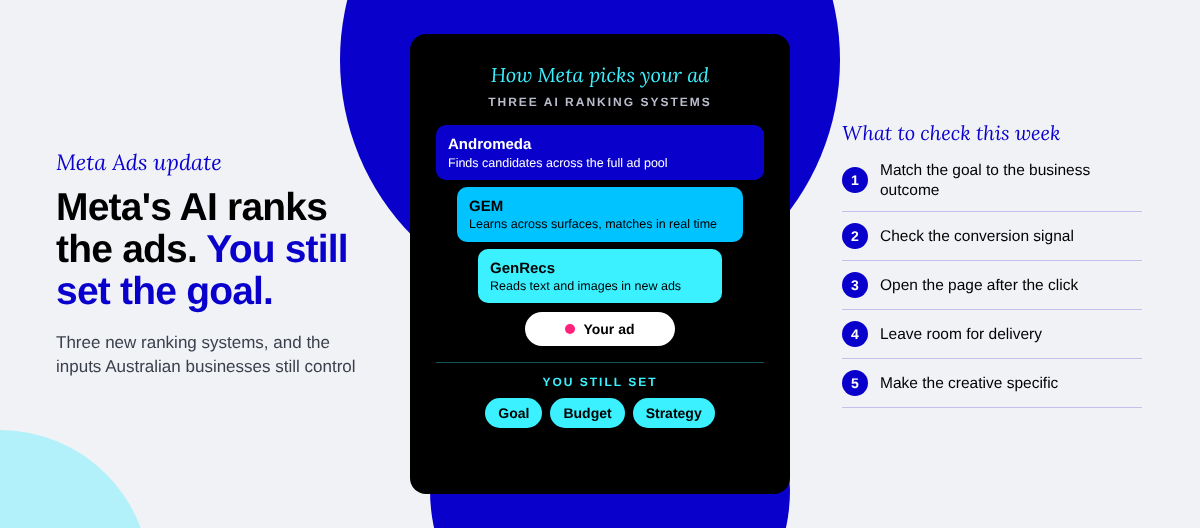
On Monday, you open Ads Manager and wonder whether your settings still matter. They do. Meta’s AI now scans the full ad pool for candidates, but you still set the goal, budget and strategy. This week, check the action your campaign pursues, the data it receives, the page people land on and the clarity of your ads.
Key takeaways
- Meta uses Andromeda, GEM and GenRecs to find and rank ads, but advertisers still choose the business goal.
- Meta reports up to 18.9% more conversions from GEM across its ad surfaces and objectives. That is Meta’s platform-level measurement, not your forecast.
- OO best practices: check conversion tracking, the landing page and the creative before narrowing an audience.
What did Meta actually change inside ad ranking?
Meta describes three systems that help decide which ads to consider and how to rank them. In its 28 October 2026 explanation, Meta says the first step is retrieval: finding a shortlist from tens of millions of available ads. An advertiser still has to tell the system which outcome matters.
Andromeda is the retrieval engine. Meta says it can now scan the full ad pool instead of checking only the most familiar candidates. Its comparison is a shop assistant who reads every product label, rather than browsing the popular shelves. That describes candidate selection, not a guarantee that every ad will be shown.
GEM learns across Meta’s advertising surfaces and trains specialist models that match ads with people in real time. It teaches the smaller systems rather than directly choosing every auction winner.
GenRecs helps interpret an ad with little engagement history. Meta says its tokenisation reads text and images, then assigns markers for attributes such as brand, colour, fit and style. A new ad can be related to ads the system already understands. That does not make an unclear offer attractive.
Do Meta’s numbers mean your results will improve?
No account-level improvement follows automatically from Meta’s published figures. Meta reports that GEM delivered up to 18.9% more conversions and 12% higher ad click-through rate across its ad surfaces and objectives since 2025. In its companion post, Meta reports 8.3% more ad clicks and 15.7% more Facebook conversions in Q2 2026 from several model advances together.
Those are Meta-reported platform-level measurements, not an independently verified forecast for a Perth electrician or an Australian consultancy. They also cover different systems, periods and groups. You cannot add them up to predict a campaign result. Meta says the benefit depends on the outcome you ask the system to pursue, the quality of your data and how much optimisation you let it handle.
For an owner, the useful question is whether better matching is being fed a trustworthy signal. More clicks are not enough if the campaign counts the wrong action, or if the page after the click makes an enquiry harder than it needs to be.
What actually decides whether your ad wins an auction?
Meta names three main auction inputs: your bid, ad quality and estimated action rate. Its auction explanation says the highest budget does not automatically win. A relevant ad with a better customer experience can beat a higher bid.
Your bid reflects what you are willing to pay for an impression. Meta converts your budget, goal and cost constraints into bids, adjusting them as opportunities change. Estimated action rate predicts whether this person will take your chosen action. Ask for the wrong action and the prediction chases the wrong prize.
Ad quality includes the ad and the experience after a click. Meta says it considers whether people view, click or hide an ad, detects traits such as engagement bait, and uses more than 200 million customer survey responses a year about purchases, delays, unexpected charges and feeling misled. A page that buries the offer deserves attention. For a practical post-click check, see our guide to form and call-to-action placement.
What should you check this week?
Start with the inputs you control. The first three checks concern the goal, the measurement and the experience. The final two help the system understand and deliver the ad. This is OO’s best practices guidance informed by Meta’s account of its ranking system, not a new list of settings announced by Meta.
- Match the goal to the business outcome. If you need qualified enquiries, ask whether the campaign’s optimised action represents a useful enquiry. A form opening is not the same as a submitted lead. Meta says it can only optimise for the objectives you give it.
- Check the conversion signal. Confirm the actions reported by your website pixel and Conversions API (CAPI) are complete, accurate and tied to the right outcome. OO best practices: compare recorded leads with the enquiries your business actually received before trusting a trend.
- Open the page after the click. Is the promised service clear? Can someone make an enquiry on a phone without hunting for the form? Meta includes the post-click experience in ad quality, so this check affects more than the page’s conversion rate.
- Leave room for delivery where volume is the aim. OO best practices: do not tighten an audience simply because delivery moved. Check your goal and signals first, then judge the resulting leads. Broad delivery is a choice, not an instruction to abandon safeguards.
- Make the creative specific. Name the actual service, area served and offer in the ad where appropriate, and use imagery that shows what is being sold. Meta’s tokenisation reads attributes of text and images. OO best practices: keep the message useful to a person first. Our social media marketing overview covers the wider role of useful creative.
When do manual settings still matter?
They matter when they express a business limit. Meta says advertisers set strategy, budget and goal. OO best practices are to retain relevant hard controls such as geography, minimum age, language and custom-audience exclusions where needed. The two ranking posts neither announce new controls nor advise removing existing ones.
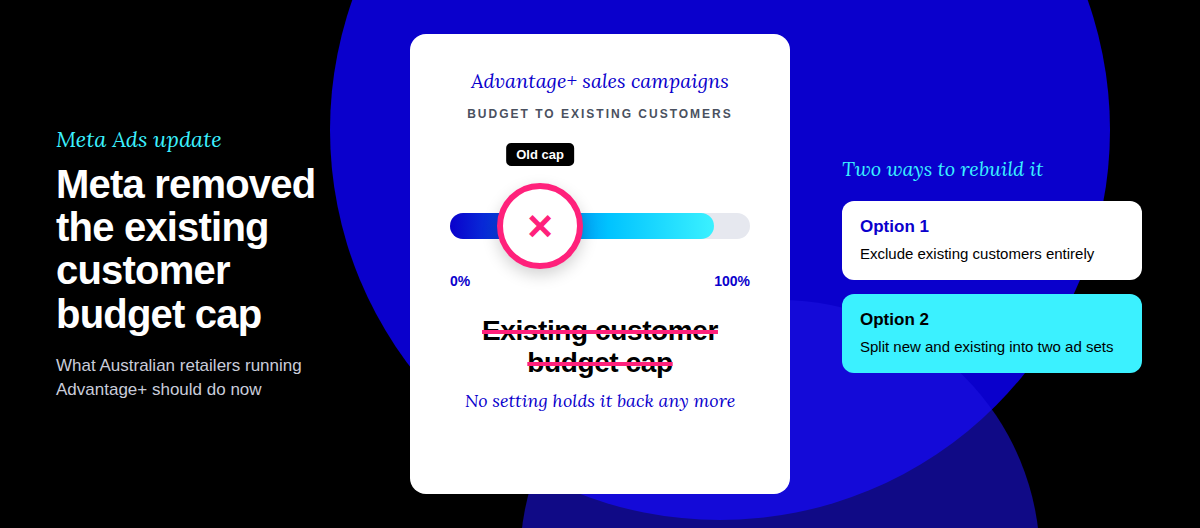
If you need to distinguish new customers from existing ones, read our Advantage+ existing customer budget cap guide for a separate discussion of customer controls. If you are comparing AI-led advertising platforms, our ChatGPT ads explainer is a separate starting point.
What should you do next?
Spend this week’s effort on the objective, the conversion signal, the experience after the click and ads that show plainly what you sell. Only then decide whether an audience limit solves a real problem. Meta can search and rank more intelligently, but it cannot know which enquiry is worth having unless your campaign and measurement tell it. If you want a second set of eyes on that setup, see how our digital advertising service approaches it.
Sources
Meta for Business, Inside the Three New AI innovations in Ads Ranking Improving your Ad Performance, 28 October 2026, accessed 2 November 2026.
Meta for Business, How Meta’s Ads System Matches Your Ad to the Right Person at the Right Time, 28 October 2026, accessed 2 November 2026.