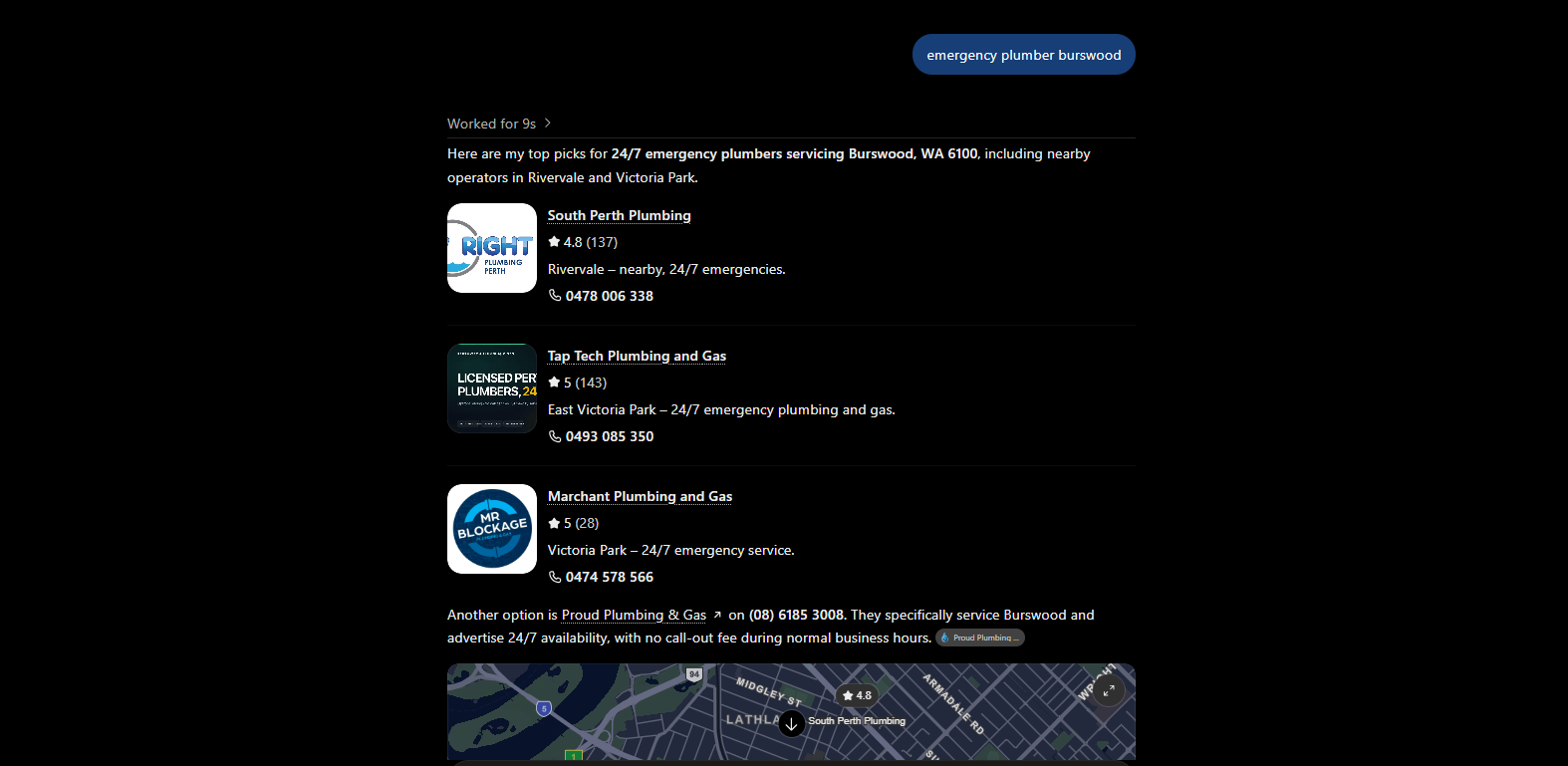
You ask ChatGPT for an emergency plumber in your suburb and it names three businesses. None of them is yours. One of them quoted against you last month. So why them?
This month Ahrefs published one of the largest public looks at how ChatGPT finds its answers, and it is more useful than most of the “get recommended by AI” advice doing the rounds. It analysed 66.6 million ChatGPT answers and 15 million of the follow-up searches ChatGPT ran behind the scenes, across August and September 2026. The short version: there are two ways into an answer, and you can work on both.
Key takeaways
- In Ahrefs’ study of free, logged-out ChatGPT (August to September 2026), only 14.4% of answers involved a web search. The rest came from what the model already knew.
- When ChatGPT did search, it went looking for facts at the source: brand websites, prices, reviews and “official” pages.
- Put your services, prices, suburbs and hours in plain text on your own site, and keep collecting genuine reviews on independent sites.
How does ChatGPT choose what to recommend?
ChatGPT doesn’t rank businesses the way Google ranks pages, and nobody can guarantee you a mention. What the Ahrefs data shows is two separate paths into an answer.
Path one is what it already knows. Only 14.4% of the responses Ahrefs tracked triggered a web search, so roughly six in seven were answered from memory. Ahrefs points out that every search costs OpenAI money, so the model skips one when it can answer well enough from what it already knows. For a local business, that likely means plenty of answers are shaped by what has been written about you across the web long before anyone asks: your website, your reviews, your directory listings, any local media coverage.
Path two is what it checks. When ChatGPT did search, it ran about 1.6 follow-up searches per answer (Ahrefs calls these fan-out queries). 6.8% of them used a site: search to look inside a single website, and 75.9% of the most common site: searches pointed at a brand’s own site rather than a retailer, forum or review site. The words inside those searches lean towards facts. “Official” appeared in 13.1% of English fan-outs in September, up from 10.1% in August. “Price” rose from 6.0% to 8.9%.
One line for Australian owners: fan-outs containing “australia” roughly tripled over the same month, from 1.4% to 4.3%.
Facts come from you, comparisons lean on everyone else
In a separate Ahrefs test of 20,000 US prompts, 84.4% of factual questions about pricing, product features or company details cited at least one official source. For comparison questions such as “A vs B” or “which is cheaper”, that dropped to 68.3%, and official websites made up only 46.4% of the citations. Most of the citations went to other sites.
Put that in trade terms. A customer asking what a gas hot water replacement costs is likely to get an answer built from business websites, yours included if the facts are there. A customer asking who is better, you or the business down the road, gets an answer that leans on reviews and other people’s opinions.
Reddit is not the shortcut it was
If someone has told you to post on Reddit to get into ChatGPT, the data has moved on. In Ahrefs’ US citation data, about one in five ChatGPT answers cited Reddit in March. By late September it was about one in 43. Wikipedia fell from one in seven answers to one in 35.
Ahrefs reads this as ChatGPT moving towards original sources and away from sites that summarise them. In its words, the pages holding up best are “the ones only you can publish, like original research, hands-on testing, and your own product facts.”
Check what ChatGPT would find on your site
You don’t need a tool to run a first pass. Open your own website and look for the facts those fan-out searches hunt for.
| What the searches look for | Where it should live | Quick test |
|---|---|---|
| Prices or price ranges | A services or pricing page, written as text | Can you find a price without opening a PDF, an image or a quote form? |
| Services you offer | A page for each main service | Does each service have its own page with a plain description of the job? |
| Where you work | Suburbs named in real words on your pages | Search the page (Ctrl+F) for your three busiest suburbs. Are they there? |
| Hours and contact details | Contact page and footer | Are your hours typed out, or only shown in an image? |
| Reviews | Google Business Profile and other independent review sites | Are your reviews genuine, recent and in your customers’ own words? |
Then ask ChatGPT the question your customers ask, such as “emergency plumber” plus your suburb. Note which businesses come up and which sources it cites. Ahrefs notes that free, logged-out sessions search less than paid or reasoning models, and results shift from week to week, so treat this as a spot check rather than a score.
What to change this month
- Put the money facts in plain text. Services, prices or price ranges, suburbs, hours and warranty terms belong on your own pages as readable text. A quick fact-check search has little to work with when the price only lives inside a PDF.
- Name your service area in real words. “Servicing Perth” is vague. Joondalup, Wanneroo and Clarkson are facts.
- Collect genuine third-party reviews. Comparison questions lean on other sites, so what customers say about you elsewhere carries weight.
- Publish proof only you can publish. Real job photos with honest descriptions, case studies and your own pricing explainers. A rewritten version of someone else’s explainer gives ChatGPT a reason to cite the original instead.
One caveat worth knowing. Ahrefs studied free, logged-out ChatGPT between August and September 2026, and it says OpenAI changes how ChatGPT retrieves information constantly. The numbers describe two months of one model.
For the next step, read our guide on how to get cited by ChatGPT, Gemini and Perplexity, see how AI search is affecting trades businesses, and check what content still works in AI search. If you’d like us to check what ChatGPT can find about your business, get in touch with the team for a visibility check.
Make sure the facts it finds are yours
Most of the time ChatGPT answers from memory. When it does go looking, it goes looking for your prices, your suburbs and your reviews. Get those right on your own site, in your own words, and you give it something true to repeat.
Sources
- Ahrefs, How ChatGPT Does Query Fan-Out (15 Million Queries Studied), published 12 October 2026, checked 19 October 2026.